
Inside Chapters 3–5 of An Advanced Guide to China Sourcing and Procurement
January 10, 2026
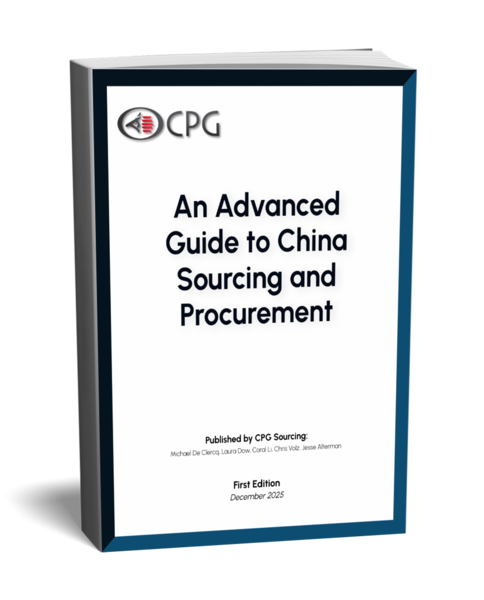
In Episode 6 of CPG’s podcast, The Supply Chain of Thought, CPG CEO Michael De Clercq and Business Director Laura Dow continue their walkthrough of An Advanced Guide to China Sourcing and Procurement, the upcoming e-book written by the CPG Sourcing team.
In Episode 5, we introduced why we wrote the book and explored Chapters 1 and 2, covering on-the-ground sourcing operations and verified sustainability in China’s supply chains. Episode 6 picks up at Chapter 3 and moves through three foundational topics that determine whether a sourcing program succeeds or fails: quality assurance, contract structure, and communication.
Across all three chapters, one message is consistent: sourcing success is not based on assumptions. It’s built on clear definitions, disciplined execution, and systems that prevent problems before they happen.
Chapter 3: Quality Assurance: The Evolution and Execution of Excellence in Chinese Manufacturing
Chapter 3 addresses one of the most misunderstood parts of China sourcing: quality isn’t a single standard. It is defined by the buyer, and it must be specified in a way that is measurable, enforceable, and repeatable.
Quality is one of CPG’s “three essentials,” alongside price and on-time delivery. You can negotiate a strong price and still fail if quality slips. You can deliver high quality and still fail if delivery is late. A sourcing program only works when all three are secured consistently.
Broad terms like durable are not actionable until they are translated into requirements. Durability for a 50-cent kitchen spatula is not the same as durability for a $5,000 aerospace component. Both demand durability, but the definition “diverges radically” depending on use case, operating conditions, and performance expectations.
This chapter also walks readers through the tools and systems that make those tiers enforceable in practice, including AQL tables, inspection specification sheets, and the PDCA cycle (Plan–Do–Check–Act).
The takeaway: quality is not “good” or “bad.” It is what you specify, what the factory agrees to produce, and what your process verifies throughout production.
Chapter 4: Contract Negotiation in China Sourcing
Chapter 4 tackles a reality that surprises many experienced buyers: a shocking number of China sourcing relationships operate without a formal contract.
Many companies rely on pro forma invoices, WeChat exchanges, or informal written confirmations, sometimes even after years of buying from the same supplier. That approach often works until it doesn’t. And when it fails, the cost can be severe.
The value of a contract is not primarily about going to court. If you’re at the stage of litigation, the damage has already occurred. A sourcing contract’s primary purpose is clarity: ensuring both parties are aligned on responsibilities, standards, timelines, and remedies before production begins.
The chapter also addresses a critical China-specific detail many Western buyers miss: contracts must be “chopped” (stamped with the official company seal) to be considered valid and enforceable in China.
The takeaway: contracts don’t slow sourcing down. They prevent costly ambiguity and protect your investment.
Chapter 5: Optimizing Communication for Sourcing Success
Chapter 5 reframes communication as more than a soft skill. In China sourcing, communication is an operational system, and failures in that system are often the root cause of downstream disruptions. Michael references a classic principle:
the biggest problem in communication is the illusion that it has taken place.
This chapter emphasizes that good communication is not just clarity in one email or one meeting. It is consistent clarity across: teams, time zones, documents, and decision-makers. Communication must be reinforced through documentation, verification, and repeatable processes, not assumptions.
The takeaway: communication is not the final step; it is the connective tissue that determines whether your quality systems and contracts actually work.
Where This Leaves Importers
Chapters 3–5 reinforce why we call this an advanced guide. These aren’t theoretical concepts. They are the practical disciplines that separate stable sourcing programs from expensive surprises.
If these topics resonate, we invite you to listen to Episode 6 of The Supply Chain of Thought, where Michael and Laura share real-world examples and expand on the chapters’ key lessons.
And if you prefer to read rather than listen, you can find the full transcript directly below: https://cpgsourcing.com/wp-content/uploads/2026/01/Podcast-EP6-Transcript.docx.pdf