
Whispering Sweet Nothings
March 18, 2026
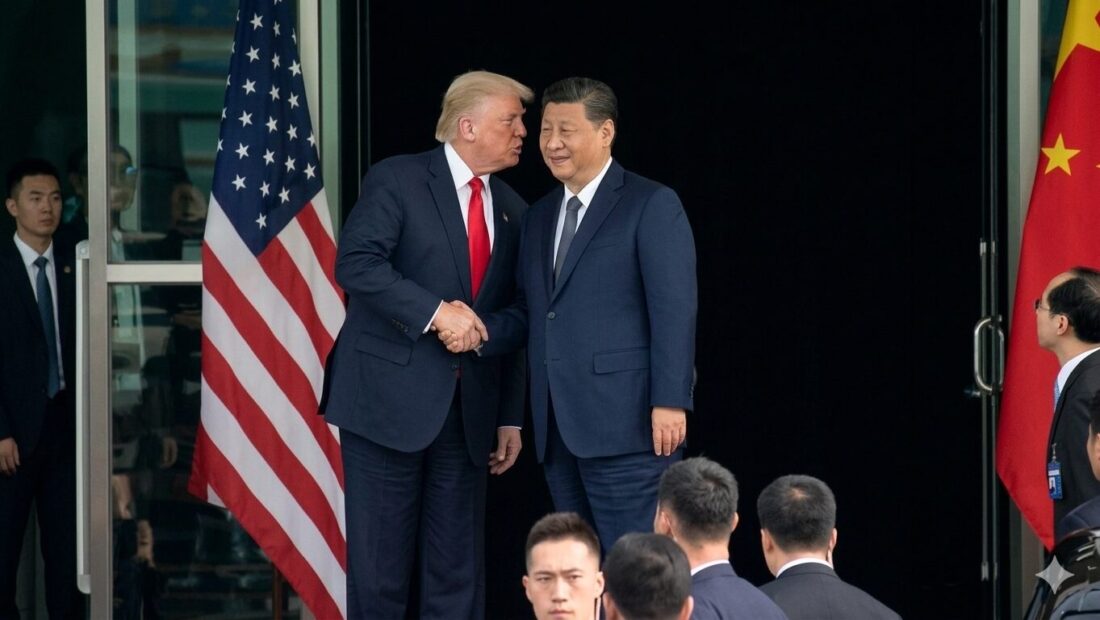
There is a photograph that remains etched in our minds. In it, Xi Jinping and Donald Trump are leaning toward one another, captured in a moment of apparent intimacy. They are smiling, their body language suggests a shared confidence, a moment of genuine human connection amidst the gilded backdrop of statecraft.
They look as though they are whispering sweet nothings.
Yet neither truly speaks the other’s language. Not fluently. Not instinctively. Not culturally. Not at all.
Between the smile and the understanding stands a phalanx of interpreters, cultural advisors, and briefed experts. Without them, those “sweet nothings” gestures—the nods, the handshakes, the shared laughs—would be devoid of actionable meaning.
This image is an excellent metaphor for the current state of East-West trade. On the surface, there is the cordiality of the contract and the handshake. But beneath the surface lies a profound divide:
Different languages.
Different cultural assumptions.
Different concepts of hierarchy and authority.
Different attitudes toward contracts and relationships.
Different political systems.
Different definitions of time.
And yet — trade flourishes. Because incentives align even when cultures do not.
The Western buyer wants reliability, margin, predictability, and growth.
The Chinese manufacturer wants stability, scale, reputation, and prosperity.
The Silent Tax on Global Trade
Most failures in international sourcing are not caused by bad intentions.
They are caused by misunderstanding.
A specification interpreted differently.
A tolerance assumed rather than documented.
A timeline understood as flexible by one side and fixed by the other.
A handshake seen as symbolic by one party and binding by the other.
Surface harmony often masks structural misalignment. The real cost of global trade is not tariffs. It is misinterpretation.
This is the silent tax.
For nearly five decades, CPG has operated in this space — not as a broker of transactions, but as an active player and a translator of systems.
We translate language, yes.
But more importantly, we translate circumstances and expectations.
We translate compliance requirements.
We translate operational discipline.
We translate risk tolerance.
We translate quality culture.
We translate governance.
Price, Quality, On-Time Delivery.
Simple words. Difficult execution.
The lowest quote is rarely the lowest cost.
The friendliest factory is not always the most reliable partner.
The fastest promise is not always the most durable solution.
What is required is experience and structure.
Structured vetting.
Structured quality control.
Structured communication.
Structured escalation procedures.
Structured relationship management.
What is key is relationship capital and it is not built in a negotiation; it is built over time. And in China, as in the West, trust compounds.
Prosperity Without Sameness
Global trade is not about creating identical systems. We do not need the East to act like the West, nor the West to adopt the habits of the East. Prosperity does not require sameness; it requires a bridge.
The companies that thrive are not those who attempt to eliminate differences. They are those who learn to navigate them, to benefit from them.
Global trade is not about whispering sweet nothings.
It is about understanding what is truly being said — and what is not.
The future belongs to the best translators. It belongs to those who can navigate the silence—the leaders who understand that while we may whisper sweet nothings at the banquet table, the real work is done by those who translate those whispers into results.
At CPG, we don’t just bridge the gap; we own the crossing.